The Gravity of Readiness: Why Work at Height Training Demands VR Immersion
High-altitude falls consistently rank as the primary cause of workplace fatalities in the construction and industrial sectors. A single moment of distraction—a safety clip left unhooked or a harness buckle not fully seated—is a death sentence. The fundamental flaw in standard Health, Safety, and Environment (HSE) classroom sessions is the “Safety Paradox”: you cannot adequately prepare a worker for the psychological trauma of a 50-story drop using a slide deck on the ground floor.
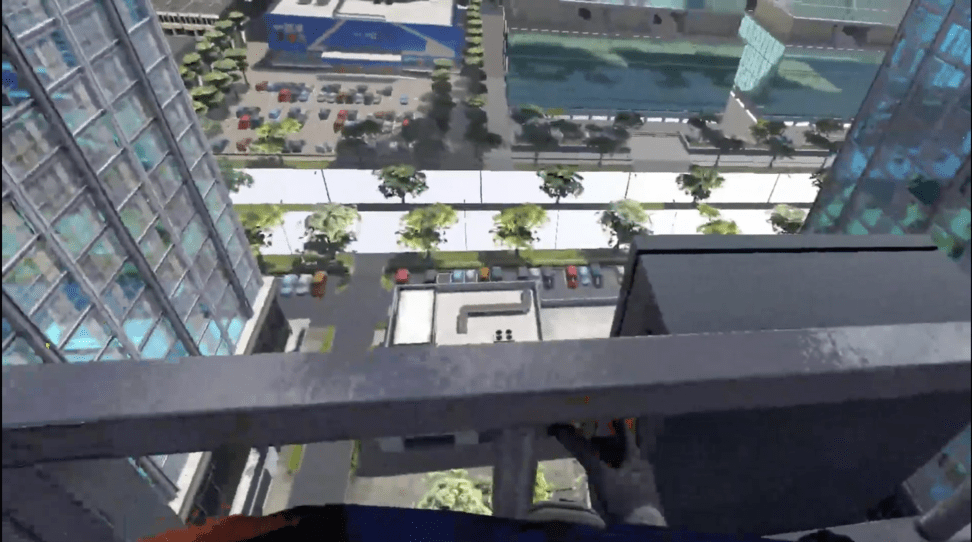
To drive genuine behavioral transformation, the workforce needs to feel the gravity. The VGLANT VR Work at Height module (a member of VIRTU) bridges the gap between theoretical rules and visceral reality. It places your team on a suspended platform scaling a massive skyscraper, forcing them to operate while their brain is screaming for safety.
1. High-Fidelity Logistics: The Suspended Scaffold Scenario
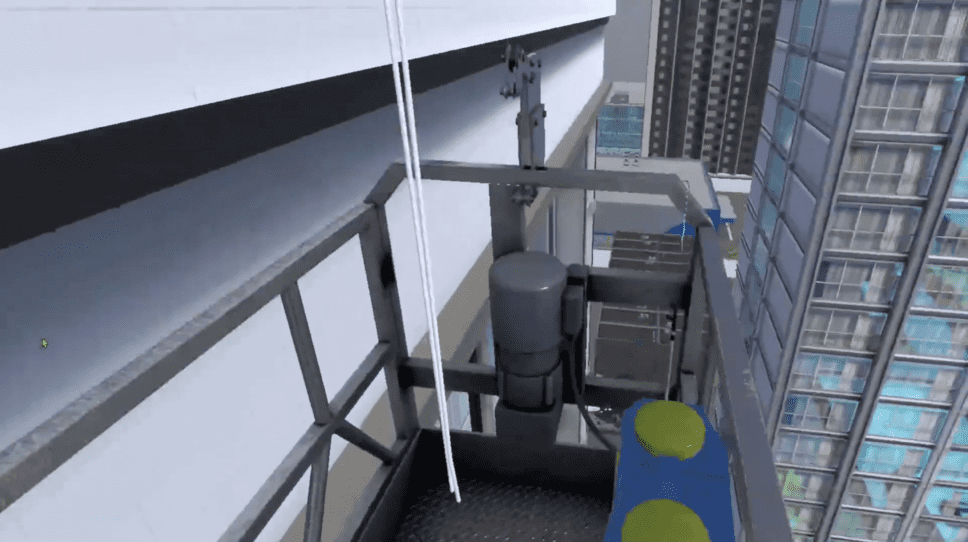
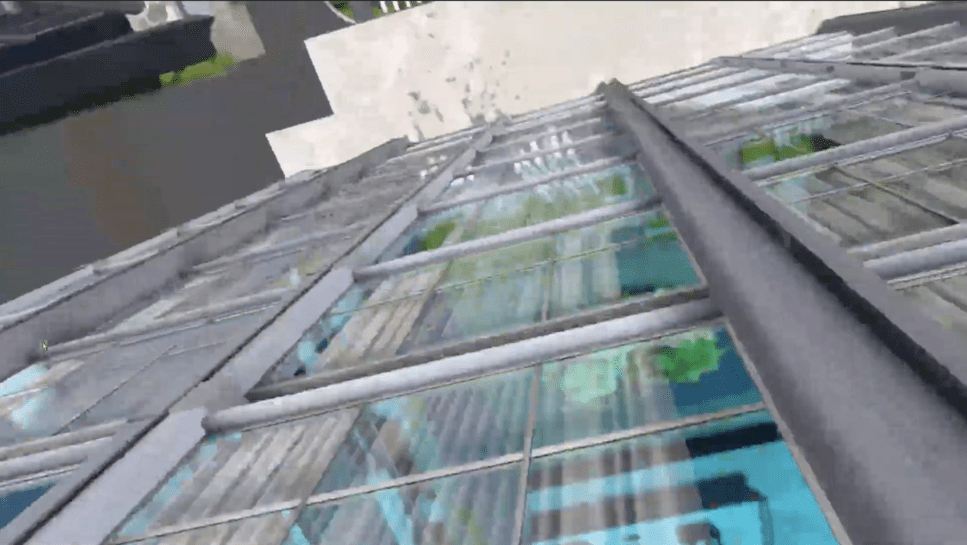
Tailored for facade cleaners, construction teams, and high-rise maintenance crews, this module drops the trainee onto a motorized gondola ascending a glass skyscraper.
- Advanced Spatial Audio: The sound of wind shear and the mechanical hum of the gondola motors are rendered in 3D, inducing a genuine sense of vertigo.
- 1:1 Depth Perception: By utilizing high-fidelity textures and realistic scale, the virtual environment commands immediate respect.
- Mechanical Interaction: Trainees are not just spectators. They must maneuver through the narrow confines of the platform and interact with the mechanical winches and control systems.
However, the absolute focus of the module is not the maintenance work—it is the mastery of the Personal Fall Arrest System (PFAS).
2. The “Safe-to-Fail” Protocol: Consequence-Based Learning
In the physical world, forgetting to anchor a lanyard results in an irreversible tragedy. In a traditional training room, it is merely a red mark on a multiple-choice exam.
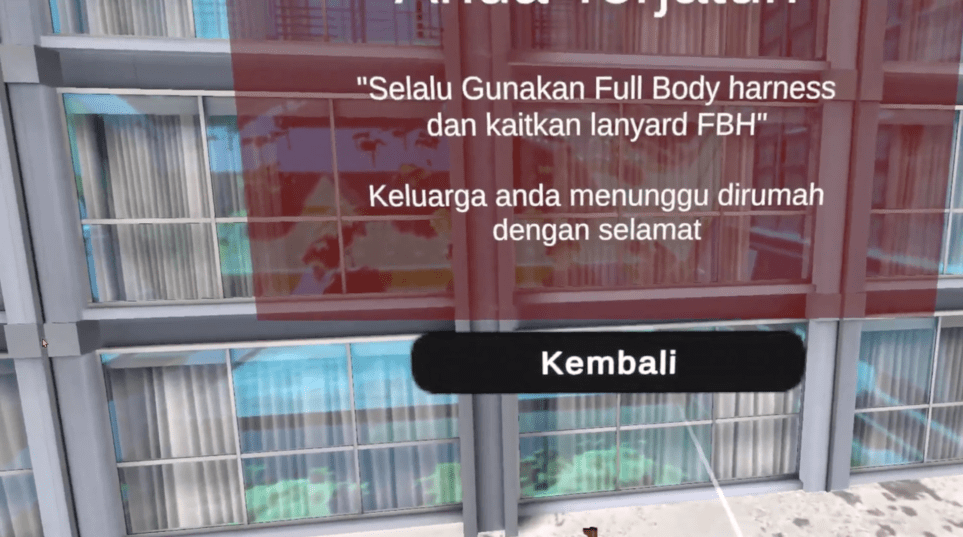
VGLANT radically shifts this paradigm through consequence-based learning. If a user fails to properly secure their Full Body Harness (FBH) and missteps or experiences a simulated platform malfunction, the simulation does not forgive. The trainee experiences a rapid, terrifying free-fall. They see the ground rushing up in a 1:1 scale descent that ends in a stark visual of the impact.
The experience concludes with an emotionally grounded reminder:
“Selalu Gunakan Full Body harness dan kaitkan lanyard FBH. Keluarga anda menunggu dirumah dengan selamat.” (Always use a Full Body Harness and attach your FBH lanyard. Your family is waiting for you at home safely.)
This visceral shock converts standard compliance into a deeply ingrained survival reflex. It teaches the fatal cost of negligence without risking actual physical harm.
3. Core Competencies and Technical Analytics
By navigating the VGLANT simulation, operators achieve mastery in several critical domains that a manual cannot teach:
- Situational Composure: Managing height-induced anxiety (vertigo) and sustaining operational focus in extreme, high-altitude conditions.
- Harness Discipline: Building the automatic muscle memory needed to inspect, wear, and anchor an FBH before engaging in elevated work.
- Hazard Recognition: Identifying spatial limitations, platform swing mechanics, and unprotected edges while working on a moving scaffold.
4. The VGLANT Advantage for HSE Managers
As a core brand under VIRTU, VGLANT provides more than just a visual experience. We provide a data-driven safety audit.
- Absolute Safety: Expose your teams to extreme scenarios repeatedly without ever risking a Lost Time Injury (LTI).
- Deep Emotional Resonance: By showing the harsh consequences of a fall, we focus on the human impact. Workers remember why safety gear matters, not just how to put it on.
- Actionable Analytics (TDR): The integrated dashboard logs every session detail. HSE administrators gain clear, objective insights into which employees successfully anchored their lanyards and who requires immediate intervention prior to field deployment.
Conclusion: Refusing to Imagine
Stop relying on imagination to instill critical safety protocols. Allow your workforce to experience the edge safely with VGLANT. Ensure that proper fall protection becomes an unbreakable habit before they ever step onto a real job site. In the high-stakes world of industrial maintenance, the only thing more expensive than a VR simulator is a single unforced error at 500 feet.