There’s a pattern that keeps showing up when Military and Law Enforcement institutions adopt VR combat training. Significant investment flows into headsets, software, and training space. Vendors are invited for demos, contracts get signed, equipment arrives. Then — in many cases — the results disappoint. Not because the technology is bad. But because one variable consistently slips through the cracks: the instructor.
Most discussions about VR adoption circle around trainees and technology. Yet the variable that actually determines whether the investment produces field-ready competence or just an expensive toy is the instructor running it. This role changes substantially when VR arrives. Institutions that ignore those changes often end up with ROI well below expectations, even when the hardware is state-of-the-art.
This piece breaks down what changes for tactical instructors when VR is adopted, what stays the same, and how institutions can develop instructor capability for the evolving role.
What Doesn’t Change: The Foundation That Stays Solid
Several aspects of the instructor’s role don’t fundamentally shift with VR adoption.
Tactical expertise depth remains the foundation. Effective training scenarios still need someone who deeply understands tactics. Why one entry sequence is more effective than another in a particular layout. What realistic threat behavior actually looks like. How rules of engagement apply in specific situations. No software can substitute for this, no matter how sophisticated the platform.
Mentoring capability still matters. Effective after-action review needs an instructor who can translate observations and data into actionable insights, read individual trainees personally, and deliver feedback constructively. These skills remain inherently human.
Holistic assessment of trainee competence still requires instructor judgment. Data analytics can measure many performance dimensions. But qualities like judgment under pressure, ethical decision-making, and leadership — they’re hard to fully quantify. Experienced instructors continue to assess these dimensions in ways software hasn’t been able to match.
Authority and credibility with trainees largely rest on demonstrated operational experience. An instructor who’s actually done the work earns a different kind of respect — and that respect shapes how feedback gets received. Independent of whether training happens in a kill house or a VR environment.
These elements form the durable core of an instructor’s professional identity. VR adoption doesn’t threaten them.
What Changes: New Realities to Adapt To
Meanwhile, several substantial things shift in how instructors work in VR-equipped programs.
The delivery medium shifts. Instructors who used to brief trainees in person, watch them work in physical environments, and debrief face-to-face now also work through dashboards, communicate via headsets, and observe through monitors. Physical presence with trainees during exercises gets reduced or restructured.
Technical skill requirements expand. Operating a scenario dashboard. Building or modifying scenarios. Troubleshooting technical issues. Managing data outputs. All part of the job now. Instructors don’t need to become software engineers. But they do need to be comfortable working with technology beyond what previous roles demanded.
Scenario design becomes a core competency. In conventional training, scenarios are largely defined by available facilities and resources. In VR training, scenarios get designed deliberately — which makes scenario design itself an important skill. Instructors need to develop the ability to translate training objectives into specific virtual environments.
Real-time scenario management during sessions needs new skills. Instructors can adjust scenarios mid-session. Spawn additional threats. Change environmental conditions. Trigger events. Communicate selectively with individual trainees. These capabilities expand what training can do, but require new judgment about when and how to use them.
Data interpretation becomes part of after-action review. AAR with heatmaps, performance metrics, and 3D replay needs instructors who can read and interpret data — not just describe what they observed. A different kind of analytical work than conventional AAR.
The Operator Dashboard: New Tools to Master
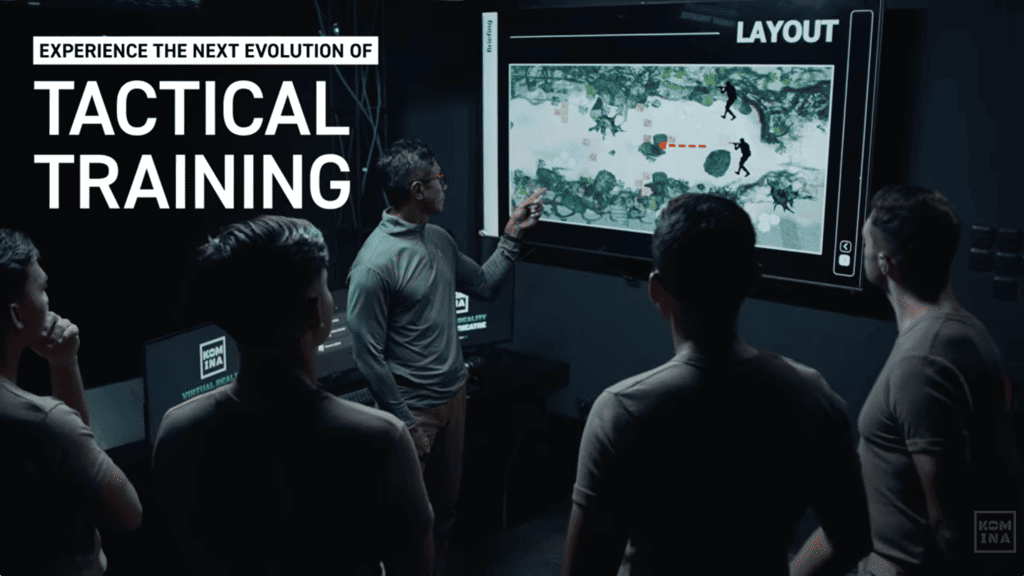
A central element of the changed instructor role is the operator dashboard. Most professional VR combat training platforms give instructors a control interface with several common elements.
Multi-view monitors typically show different perspectives on the active scenario. Overhead tactical map. First-person views of individual trainees. Overview shots. Instructors switch between views to observe different aspects of the exercise.
Scenario controls enable real-time adjustments to variables. Lighting, weather, environmental hazards, threat behavior parameters — all of it can be modified without pausing the exercise.
Event triggers let instructors introduce events during scenarios. Additional threats appearing. Equipment malfunctions. Communication problems. Civilian behaviors. Other developments. Makes scenarios dynamic rather than pre-scripted.
Communication channels let instructors talk with individual trainees or the whole team. Used for guidance during exercises, post-incident questions, or full intervention when appropriate.
Recording and annotation tools let instructors mark important moments during exercises for later review, and add notes that provide context for AAR. Similar to how athletic coaches mark game footage for later analysis.
The dashboard interface is initially complex for new operators. Most instructors need weeks of practice before working comfortably with the full feature set. Similar to learning any complex professional software environment.
The New Skill Set That Needs Building
A few specific skills become important for tactical instructors working in VR-equipped programs.
Scenario design thinking is the ability to translate training objectives into specific scenario configurations. Means thinking about what variables stress particular skills, how scenarios should progress in difficulty, what randomization keeps scenarios fresh, and how scenarios chain into broader training programs.
Data literacy is the ability to read performance metrics, spot patterns in training data, and tell signal from noise. Doesn’t require formal data science training. Does require comfort with quantitative information that some instructors haven’t developed in previous roles.
Dashboard multitasking is the ability to manage multiple information streams during exercises. Observing trainee performance. Monitoring scenario state. Considering when intervention is appropriate. Noting issues for later review. Cognitively demanding. Develops with practice.
Communication with development teams matters when instructors want new features, scenarios, or fixes. The ability to articulate tactical requirements in terms technical teams can implement is a different skill from articulating them to trainees.
Adaptation to new learning styles is sometimes necessary. Younger trainees who grew up with digital interfaces sometimes adapt to VR training faster than senior instructors expect — which can shift the instructional dynamic.
Transition Pain Points
A few challenges color the instructor transition to VR-equipped programs.
Resistance to technology adoption is common among experienced instructors who’ve developed effective approaches with conventional methods. VR can feel like an unwelcome disruption to established practice. Effective change management acknowledges this — rather than treating resistance as a problem to overcome.
The initial productivity gap during learning is real. Instructors who were highly effective with conventional methods go through a period of reduced effectiveness as they learn new tools. Normal. But it can damage instructor morale if not anticipated.
Distance from trainees during exercises feels different. Instructors in control rooms physically separated from trainees in headsets have to work harder to maintain mentoring relationships than instructors standing meters away in physical training environments.
Identity adjustment hits some instructors hard. Those whose professional identity centered on physical presence and demonstrated capability may find adjustment to operator roles difficult. Rarely discussed openly. But it affects instructor satisfaction in ways that affect program success.
Junior vs Senior Dynamics
In practice, junior instructors often adapt to VR training more quickly than senior instructors. Several factors contribute to this pattern.
Junior instructors usually have higher baseline comfort with digital interfaces — having grown up with technology earlier generations only encountered as adults. Dashboard interfaces feel familiar rather than foreign.
Junior instructors have less invested in previous training methodology. They haven’t spent decades developing approaches that VR disrupts. Adaptation is easier when there’s less to unlearn.
Senior instructors, on the other hand, bring tactical depth and mentoring experience that takes years to develop. Their value in the new environment is real, but expressed differently than in conventional training.
A pattern that works well in many institutions is pairing senior and junior instructors. The senior provides tactical depth, mentoring wisdom, and credibility with trainees. The junior provides technical fluency and rapid adaptation. Together they tend to produce stronger training outcomes than either could achieve solo.
After-Action Review Facilitation
AAR facilitation is one of the most important instructor skills in VR-equipped training. Deserves specific attention.
Effective AAR with rich data presents both opportunities and risks. The opportunity is grounding discussion in concrete observations rather than memory. The risk is overwhelming trainees with data, focusing on metrics instead of insights, or using data in ways that feel judgmental rather than developmental.
Skilled VR-era AAR facilitators learn to do several things well. They identify the two or three most important patterns to discuss instead of reviewing everything. They use data to support discussion, not replace it. They ask questions that prompt trainee self-reflection rather than lecturing. They connect findings to specific training plans for subsequent sessions.
These skills are partially transferable from conventional AAR experience. But they require adaptation to the new medium. Instructors who become fluent with data-informed AAR can deliver substantially more effective training than those who treat the data as decoration on conventional debriefs.
Developing Instructor Capability: The Institutional Strategy
Institutions adopting VR combat training should treat instructor development as a strategic priority, not a side effect of technology purchase.
Formal train-the-trainer programs are more effective than informal hand-off arrangements. Structured curriculum, supervised practice, and certification create reliable instructor competence — instead of depending on individual initiative.
Ongoing education addresses the reality that platforms keep evolving. Quarterly or biannual workshops keep instructors current on platform capabilities, scenario design techniques, and emerging best practices.
Cross-institutional learning exposes instructors to approaches used by other units. Visits between training programs, internal conferences, and forums for sharing scenarios and lessons learned — all build collective capability faster than isolated development.
Career path recognition for VR training expertise prevents the role from being seen as a secondary specialization. Career advancement should accommodate instructors who develop deep VR training capability without forcing them to leave that work for other roles.
Vendor engagement for instructor feedback helps platforms develop in directions that actually serve user needs. Channels for instructors to communicate with vendor development teams should be explicit and structured.
Considerations for the Southeast Asian Context
A few considerations apply specifically to Military and Law Enforcement institutions in the Southeast Asian region.
The tradition of strong instructor authority and seniority hierarchies in this region interacts in interesting ways with VR adoption. Junior instructors with strong VR skills may end up in positions where their technical expertise exceeds senior instructors. Institutional approaches need to accommodate this without undermining traditional respect structures.
Distance between training locations across the archipelago argues for VR’s potential to standardize training across geographically distributed units. Instructors with VR capability at central training centers can effectively contribute to training quality at remote bases.
Language and cultural localization of training content matters for regional contexts. Instructor capability to design and modify scenarios specifically relevant to regional operating environments is more valuable than reliance on scenarios designed for other contexts.
Closing Thoughts
The instructor role in VR-equipped tactical training programs is different from the conventional role. But no less central. Institutions that invest in technology without commensurate investment in instructor development tend to see disappointing results. Institutions that develop instructors thoughtfully alongside the technology see the kinds of results that justify the investment.
For tactical instructors themselves, this shift can be approached as either threat or opportunity. The threat framing emphasizes what’s lost: physical presence, kill house authority, established methods. The opportunity framing emphasizes what’s gained: the ability to multiply impact through scenario design, richer data on trainee development, the capability to drill scenarios that were previously impractical.
Both framings have validity. Institutions that help instructors navigate this transition with realistic expectations and genuine support tend to produce instructors who embrace the opportunity framing. That outcome is worth the investment required to achieve it — especially when paired with regional partners who understand that instructor development and scenario content are two sides of the same coin. Providers like komina.co, which build scenario content while also supporting train-the-trainer processes for Southeast Asian contexts, can significantly accelerate the curve of instructor capability development compared to the “buy the technology now, figure out the instructors later” approach.