Unplanned downtime is one of the most expensive operational problems in coal mining. A single haul truck out of service for an unplanned repair represents lost production tonnage measured in hundreds of metric tons per shift, fuel and labor costs that keep accruing without output, and downstream effects that ripple through the loading and processing chain. Multiplied across a fleet of 50 to 200 trucks, plus excavators, drills, dozers, and processing equipment, unplanned downtime becomes one of the largest controllable costs in coal mining economics.
Conventional maintenance approaches — preventive maintenance on calendar or hour-meter schedules, reactive repair after failure, periodic component overhauls — produce acceptable results. They also leave significant performance on the table. Predictive maintenance enabled by Digital Twin technology is increasingly used to close that gap.
This article walks through how Digital Twin enables predictive maintenance in coal mining specifically, what it actually does differently, and where Indonesian coal operations should expect operational benefit.
The Unplanned Downtime Problem in Indonesian Coal Mining
Indonesian coal mining runs at scale. Major operators — including BUMA, PAMA, Petrosea, Indo Tambangraya Megah, and Pertamina through subsidiaries — collectively produce hundreds of millions of tonnes per year across operations in East Kalimantan, South Kalimantan, Sumatra, and other coal regions. Equipment fleets are correspondingly large: thousands of haul trucks, hundreds of large excavators, mining shovels, dozers, drills, and supporting equipment in active operation.
Maintenance economics in this context are significant. Coal mining operations typically spend 25-40% of total operational cost on equipment maintenance, varying with fleet age, operating conditions, and maintenance strategy. Within that maintenance spend, unplanned events — failures that happen outside scheduled maintenance windows — carry disproportionate cost.
Unplanned downtime costs more than planned downtime for several reasons.
Production loss compounds. A truck that fails during a shift represents the repair cost plus the production tonnage that truck would have moved during the unplanned downtime — plus the downstream impact on excavator utilization waiting for trucks at the loading face.
Repair costs run higher. Components that fail unexpectedly often damage adjacent components in the failure cascade. A simple bearing replacement on a planned schedule can turn into a major component overhaul if the bearing failure went undetected and damaged the housing, shaft, or related systems.
Logistics overhead is higher. Planned maintenance happens in maintenance bays with prepared parts, available technicians, and proper tools. Unplanned breakdowns happen wherever the equipment fails, often requiring field response, equipment recovery, and improvised repair logistics.
Safety risk is elevated. Equipment failures at the working face create hazards for surrounding personnel and equipment. Recovery operations carry their own safety risk profile. Unplanned events compress decision-making timelines that planned maintenance handles deliberately.
Indonesian operations have invested heavily in maintenance optimization over the past decade. Computerized maintenance management systems (CMMS), oil analysis programs, vibration monitoring, thermal inspection, condition-based maintenance practices — all widely deployed. These approaches have measurably improved equipment reliability. They also leave a gap that purely reactive or schedule-based maintenance can’t close. That gap is what predictive maintenance with Digital Twin is designed to address.


What Predictive Maintenance With Digital Twin Actually Does
Predictive maintenance is often discussed conceptually but explained inconsistently. The Digital Twin contribution has specific operational mechanics worth working through directly.
The foundation is data integration. Equipment in modern coal mining operations generates substantial telemetry — engine performance, hydraulic system pressures and temperatures, drivetrain conditions, electrical system parameters, fuel consumption, operational utilization. This data flows from onboard equipment monitoring systems (Caterpillar Cat Minestar, Komatsu KOMTRAX, Hitachi ConSite, Liebherr Mining Truck Manager, and similar OEM platforms) into the operation’s data infrastructure.
Conventional analysis processes this data through dashboards and reports. Maintenance personnel monitor parameters, identify trends, and trigger interventions when thresholds get crossed. The approach works for parameters that show clear deterioration patterns, but it depends on human pattern recognition across large data volumes and on threshold settings being correctly calibrated.
Digital Twin moves this analysis into a different operational mode. The twin maintains a continuously updated digital representation of each equipment asset, integrating real-time telemetry with the asset’s operational history, environmental context, and known failure patterns. It doesn’t just visualize current state — it models future state based on current trajectories, comparing current behavior against expected behavior under normal operating conditions.
When the twin detects deviation patterns that match known degradation signatures, it surfaces predictions about likely failure modes and time horizons. The maintenance organization gets actionable intelligence — not “this temperature is high” but “the cooling system shows degradation patterns consistent with radiator efficiency loss; expected failure window is 80 to 120 operating hours; recommended intervention is radiator inspection during the next planned maintenance window.”
This shift — from threshold-based alerting to pattern-based prediction — is what changes maintenance economics. Interventions move into planned windows where logistics, parts, and personnel are already organized. Component damage cascades get caught before secondary damage occurs. Repair costs drop because the intervention happens at the optimal window rather than after the failure event.
Specific Digital Twin Capabilities for Coal Mining Maintenance
The general predictive maintenance value applies broadly. Several Digital Twin capabilities produce particular value for coal mining operations.
Asset-level health scoring across the fleet. Each haul truck, excavator, dozer, and drill carries a continuously updated health score derived from current telemetry, operational context, and historical patterns. Maintenance organizations see fleet-wide health at a glance, with assets ranked by predicted intervention urgency. Resources flow to the assets where they produce the most value, instead of being allocated by calendar schedules that don’t match actual condition.
Failure mode prediction with time horizons. Generic predictive maintenance flags problems. Digital Twin predictive maintenance flags specific failure modes with estimated time-to-failure ranges. The maintenance team plans interventions that address actual failure mechanisms — not generic preventive maintenance that may or may not match the developing condition.
Component-level lifecycle tracking. Major components — engines, transmissions, final drives, hydraulic pumps, undercarriage assemblies — have life expectancies that depend on operating conditions. Digital Twin tracks accumulated wear under actual operating conditions, not just hours or kilometers. Components running in heavy duty cycles show predicted end-of-life earlier than identical components in lighter duty cycles, and the maintenance plan reflects this.
Anomaly detection across multiple parameters. Single-parameter alerts often miss complex failure patterns. Failure modes like hydraulic system contamination, fuel system degradation, or drivetrain wear show up as patterns across multiple parameters that no single threshold would catch. Digital Twin pattern recognition surfaces these multi-parameter signatures earlier than single-parameter monitoring.
Operating condition impact analysis. Coal mining operations vary in operating conditions. Long-haul operations with sustained loads stress drivetrains differently than short-haul cycles. High-elevation operations affect cooling system performance. Wet season operations stress different components than dry season. Digital Twin captures the operating condition context, which means maintenance predictions match the actual operational stress on each asset.
Maintenance window optimization. Major maintenance interventions affect production. The optimization problem is balancing intervention timing against operational priorities — high production periods, weather windows, parts availability, technical resource availability. Digital Twin supports scenario analysis for maintenance scheduling, letting planners see the production impact of different intervention timing options.
Component supply chain integration. Digital Twin platforms increasingly integrate with component supply chains, surfacing parts requirements before they become urgent. Lead time for major components in Indonesian mining operations can run weeks to months. Knowing which components will need replacement in the planning horizon — not just the immediate window — supports inventory and logistics planning that reduces both stockout risk and excess inventory cost.
What the Operational Impact Looks Like
Operational benefits of Digital Twin predictive maintenance in coal mining typically show up across several measurable dimensions.
Mean Time Between Failures (MTBF) improves. Failure modes get caught earlier and interventions match actual deterioration patterns. The improvement varies by equipment class, fleet age, and baseline maintenance maturity, but the direction is consistent across implementations.
Unplanned downtime decreases. Failures that previously occurred unexpectedly increasingly happen during planned windows, or get prevented by earlier intervention. The shift from reactive to predictive maintenance is operationally measurable through the ratio of unplanned to planned maintenance hours.
Maintenance cost per operating hour decreases. Cost reduction comes from multiple sources — caught failures cost less to repair than completed failures, planned maintenance runs more efficiently than emergency response, parts logistics improve with longer planning horizons, and failure cascades that damage adjacent components get prevented.
Equipment availability rises. Overall Equipment Effectiveness (OEE) and fleet availability metrics improve as both unplanned downtime and the duration of planned maintenance interventions decrease.
Safety incidents related to equipment failure decrease. Unexpected failures at the working face are a documented contributor to safety incidents. Predictive maintenance reduces these events, contributing to overall safety performance alongside the production economics impact.
Capital deployment improves. Component and equipment replacement decisions get better data support. Operations facing decisions about whether to overhaul or replace aging equipment have better visibility into the economics of each option, supported by actual condition data rather than estimated remaining life.
The magnitude of these benefits varies by operation. Operations with mature maintenance practices and well-instrumented equipment fleets see incremental improvement. Operations starting from less mature baselines see larger improvements — but they need more foundational investment to reach the predictive maintenance baseline. The honest expectation is significant operational improvement, not transformation. Pace of improvement depends on the operation’s starting point.
Implementation Considerations for Indonesian Coal Operations
Several factors affect successful Digital Twin predictive maintenance deployment in Indonesian coal mining contexts.
Sensor coverage is foundational. Predictive maintenance depends on data. Operations with comprehensive OEM telematics (Cat Minestar, KOMTRAX, ConSite, Liebherr MTM) have the foundation in place. Operations running legacy equipment with limited telemetry need sensor retrofit programs to reach predictive maintenance capability. Sensor investment is typically the largest infrastructure cost in early-stage predictive maintenance deployment.
Data integration architecture matters. Equipment data, CMMS data, dispatch data, fuel data, and operating context data live in different systems with different formats. Digital Twin platforms require data integration layers that pull these sources into the twin’s analytical infrastructure. Operations with mature integration architectures deploy faster than operations starting with siloed data systems.
Component-level data needs depth. Generic equipment telemetry supports basic predictive maintenance. Component-level depth — vibration analysis, oil analysis integration, thermal monitoring on specific subsystems — supports more accurate failure mode prediction. Maintenance value scales with data depth, not just data presence.
Operational data discipline matters. Predictive maintenance depends on accurate operational records. Fault codes properly logged. Maintenance interventions accurately documented. Component changes recorded with installation dates and source data. Operations with disciplined operational data practices produce better predictive results than operations with informal data practices, even when both have similar sensor infrastructure.
Maintenance organization readiness affects ROI. Predictive maintenance produces value when the maintenance organization can act on predictive intelligence. Organizations that continue to schedule by calendar after deploying predictive systems capture limited value. Organizations that restructure maintenance planning around predictive intelligence capture significantly more. The organizational change runs alongside the technical deployment.
Integration with existing planning systems matters. Most Indonesian coal operations run sophisticated maintenance planning through CMMS platforms — Maximo, SAP PM, Mincom Ellipse, Pulse, and similar systems. Digital Twin predictive intelligence needs to flow into these planning systems rather than operating as a parallel platform. Operations that integrate effectively get faster adoption and better operational impact.
Bahasa Indonesia interface and local support matter operationally. Maintenance personnel in Indonesian coal operations are predominantly Indonesian-speaking. Predictive maintenance platforms with Bahasa Indonesia interfaces, locally supported deployment, and engineering teams accessible during operational hours integrate more cleanly than imported solutions with English-only interfaces and remote international support.
These considerations apply broadly across Indonesian coal operations. Each operation has specific circumstances that affect implementation. The structural factors above show up consistently.
Where Digital Twin Predictive Maintenance Doesn’t Replace Existing Infrastructure
Worth being direct about the limits.
Digital Twin doesn’t replace OEM dealer support and warranty programs. Major equipment manufacturers — Caterpillar, Komatsu, Hitachi, Liebherr — provide manufacturer-supported maintenance programs that Digital Twin predictive intelligence supplements rather than substitutes for. Operations work with OEM dealers for warranty work, major component overhauls, and manufacturer-specific technical support.
It doesn’t replace skilled maintenance technicians either. Predictive intelligence identifies what needs attention. Skilled mechanics still execute the actual maintenance work, diagnose ambiguous conditions, and handle the field-level expertise that no software replaces. Operations that view Digital Twin as a way to reduce maintenance technical capacity miss the operational reality.
Fundamental maintenance practices aren’t replaced either. Lubrication programs, regular inspections, proper operating procedures, disciplined maintenance documentation — these remain operational foundations. Digital Twin makes these practices more effective. It doesn’t substitute for them.
Operator influence on equipment health is the other piece Digital Twin doesn’t address directly. Operator practices significantly affect equipment durability. Aggressive operating styles produce more wear than disciplined operation. Predictive maintenance identifies the resulting deterioration but doesn’t change the operator factor. Operations seeing maximum value from Digital Twin typically combine predictive maintenance with operator development programs, including VR-based operator training.
A cleaner framing: Digital Twin predictive maintenance is a layer that makes existing maintenance infrastructure significantly more effective. It works alongside OEM support, skilled technicians, fundamental maintenance practices, and operator development. It doesn’t replace any of them.
Virtu is an Indonesian XR and Industry 4.0 company with a substantial portfolio in mining technology. The company’s mining client base includes BUMA (Bukit Makmur Mandiri Utama), PAMA, Petrosea, United Tractors, and Indo Tambangraya Megah — covering major segments of the Indonesian mining sector, including major coal operations.
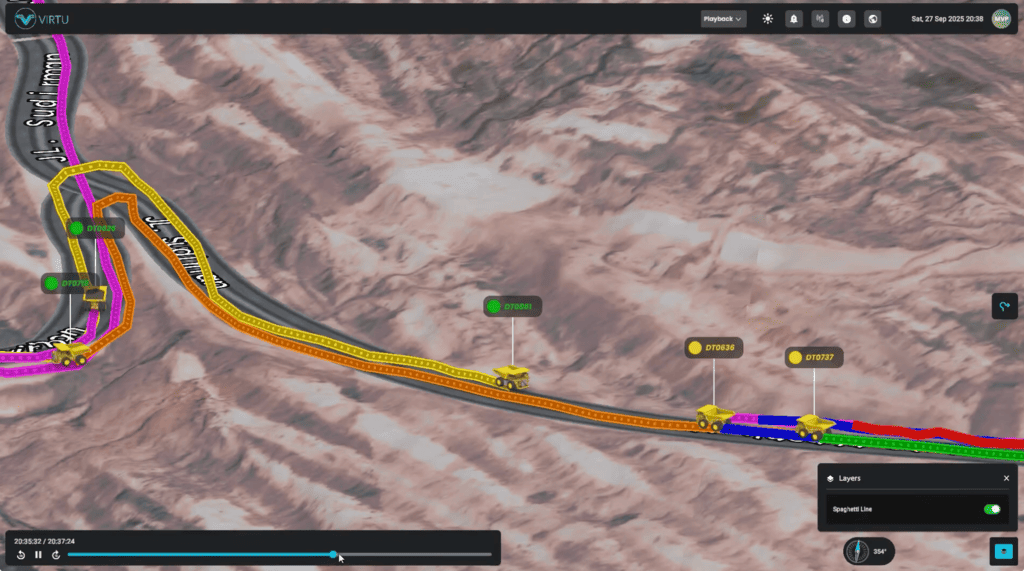
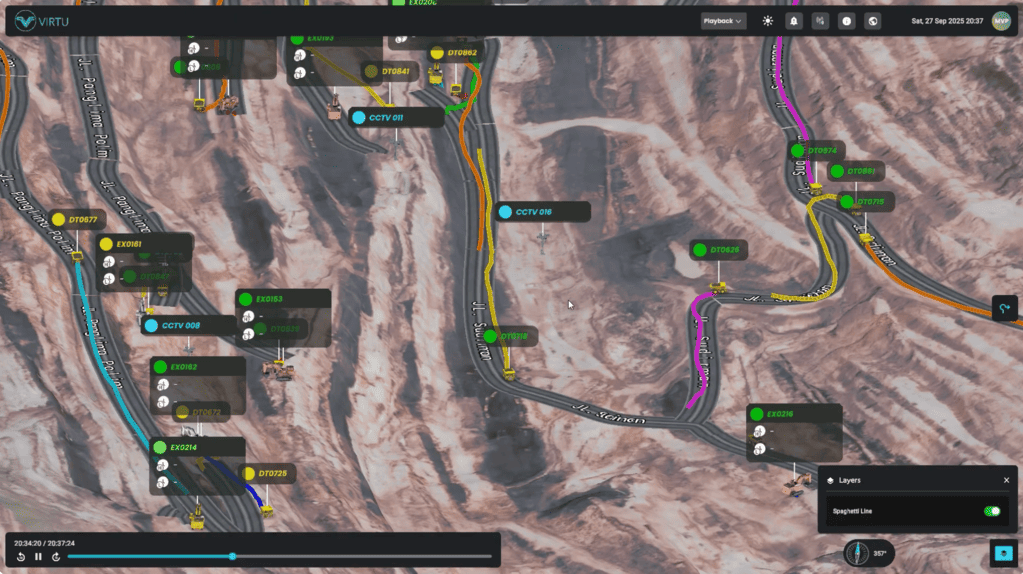
Featured Digital Twin work includes Smart Digital Twin Mining for coal mine operations, which visualizes complex terrain, vehicle data, and analytical layers in interactive platforms. The platform infrastructure supports both operational intelligence applications like predictive maintenance and operator-facing applications like Heavy Duty Mining Vehicles VR Training — which addresses the operator development side of the equipment reliability equation.
Virtu’s process for Digital Twin engagements moves through four stages: Diagnose (understanding the operational requirement and matching twin scope to actual gap), Design (architecting the twin and integration approach with existing maintenance and operational systems), Develop (building the twin and integrating with telematics, CMMS, and operational data sources), and Deploy (installation, testing, operational handover with maintenance team training).
The company is Indonesian-based, with engineering and project delivery capacity in-country. This matters for predictive maintenance work that requires sustained collaboration with site operations, maintenance organizations, IT teams, and operational stakeholders. Voice prompts and UI default to Bahasa Indonesia, with English available for multinational operations. Implementation work for predictive maintenance applications can be scoped to specific equipment classes, integrated with existing CMMS and dispatch systems, and aligned with the operation’s maintenance organization structure.
For Digital Twin scoping conversations, capability briefings, or pilot deployments specifically focused on predictive maintenance applications, Virtu can be reached through the contact form at https://virtu.co.id/ or via WhatsApp at +62 812 9696 7887.