Every discussion about mining digital twin technology eventually reaches the same question. Why does this investment make more sense than alternatives competing for the same capital? Mining operations have many places to put money — new equipment, expanded production capacity, exploration, workforce development, safety improvements. Digital twin investment needs to justify itself against these alternatives on economic and operational grounds.
The honest answer varies by operation. Digital twin technology makes strong business sense for some mining operations and marginal sense for others. Understanding which factors drive the case, and how successful operators build justifications that actually get executive approval, matters for anyone evaluating this investment for their own operations. Providers like Virtu that have implemented digital twin technology with major Indonesian mining operators offer perspective on what works in local operational contexts.
What Investment Actually Includes
Digital twin implementation is not a single-line procurement. Full implementation typically includes several cost categories that need to be visible in honest investment analysis.
Platform licensing and technology infrastructure. The software platform itself, plus servers, network infrastructure, and data storage capable of handling operational data flows.
Sensor deployment across the operation. Equipment tracking sensors. Environmental monitors. Structural sensors. Geological measurement equipment. The physical infrastructure that feeds the digital representation.
LiDAR drone equipment and operational capability. Either owned equipment and pilot capability, or ongoing service arrangements with external providers. Continuous survey requires continuous capability access.
Integration and configuration services. Connecting existing operational systems to the digital twin platform. Configuring dashboards for specific operational roles. Training users on effective platform use.
Ongoing operational costs. Software subscription renewals. Sensor maintenance and replacement. Continuous drone operations. Data storage growth. Technical support requirements.
For mid-sized mining operations, total first-year investment commonly reaches multiple billion rupiah when all components are included. Ongoing annual costs after initial implementation typically run substantial fractions of the initial investment.
What Returns Actually Look Like
Justifying this investment requires identifying returns that offset the costs. The returns fall into several categories, each with different characteristics.
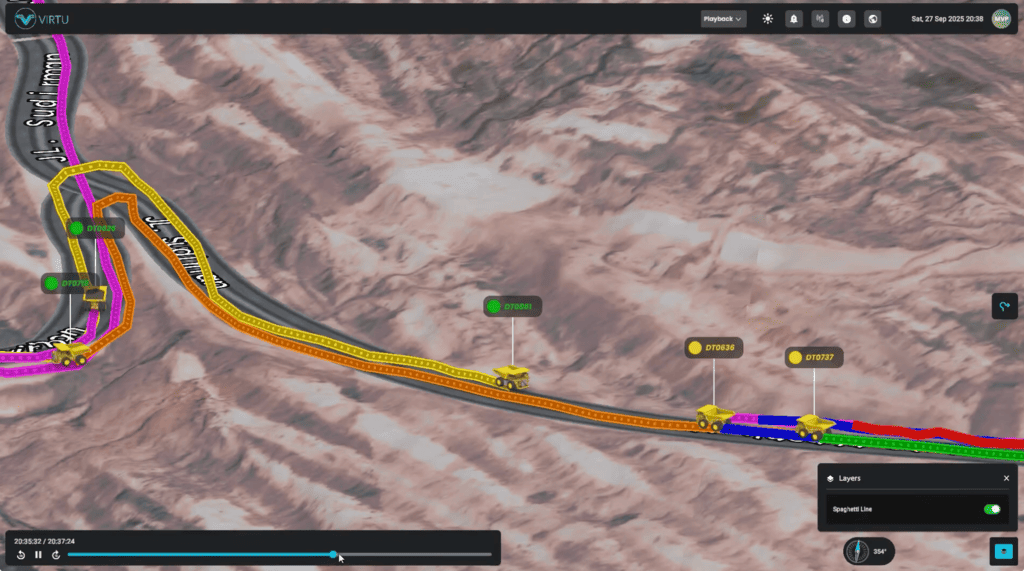
Direct operational improvements produce measurable financial impact. Reduced equipment downtime through better maintenance planning. Improved fleet efficiency through better dispatch. Reduced blast costs through better fragmentation planning. Optimized haul routes through better geometric data. Each of these can be quantified for specific operations.
Risk reduction produces harder-to-quantify but significant value. Prevented slope failures. Avoided environmental incidents. Reduced safety incidents through better hazard visibility. When these events occur, costs can reach tens of billions of rupiah plus regulatory consequences. Preventing even occasional serious incidents produces returns that dwarf digital twin investment.
Regulatory and compliance benefits accumulate over time. Documented precision in environmental monitoring. Demonstrable accuracy in production reporting. Verifiable safety monitoring. As regulatory expectations increase, operations with strong digital documentation face lower compliance burden than operations without.
Strategic capability development positions operations for future competition. Mining operations that develop digital twin capability build organizational competencies that will matter increasingly as the industry modernizes. This positioning value is real but difficult to quantify in traditional ROI analysis.
Which Operations Benefit Most
Not every mining operation gets equal value from digital twin investment. Certain characteristics amplify the returns.
Larger operations benefit disproportionately because fixed digital twin costs distribute across more operational activity. Small operations may not generate enough value across affected activities to justify investment.
Operations with high fleet counts get more value from equipment tracking and dispatch optimization capabilities. Operations with limited equipment fleets benefit less from these specific applications.
Operations with complex geology or challenging slopes benefit substantially from continuous monitoring. Operations with straightforward geology may not need the enhanced monitoring capability that justifies investment for higher-risk operations.
The Justification That Works
Successful digital twin investment justifications share certain characteristics.
They quantify specific expected benefits against specific baseline conditions. Vague promises of improved efficiency get rejected. Specific projections of reduced downtime hours, improved fleet productivity percentages, or reduced compliance costs get considered seriously.
They acknowledge implementation challenges honestly. Investment cases that promise seamless implementation without operational disruption face skepticism. Cases that acknowledge realistic implementation timelines, temporary productivity impacts, and organizational change management requirements get more credibility.
They propose phased implementation matching operational risk tolerance. Full-scale immediate deployment carries risks that phased approaches don’t. Successful cases typically propose pilot implementation, evaluation, and expansion rather than complete transformation from the start.
Where Virtu Fits
Virtu built its Smart Digital Twin Mining platform through direct experience with major Indonesian mining operators. This origin matters for investment justification because it means the platform addresses actual mining operational requirements rather than theoretical applications.
The Virtu implementation approach supports the phased deployment that successful investment cases require. Rather than requiring complete operational transformation, implementation can start with specific applications where value is clearest, then expand as organizational capability develops and value is demonstrated.
For mining operations evaluating digital twin investment, the case needs to be built on specific operational value rather than technology enthusiasm. When the numbers work for a specific operation, the investment makes sense.