Modern Indonesian industrial facilities are multi-hazard environments. A single manufacturing plant may contain ordinary combustibles in storage areas (Class A), flammable liquids in chemical processing zones (Class B), energized electrical equipment in control rooms and distribution panels (Class C), and combustible metals in specialized machining areas (Class D). Petrochemical installations add pressurized gas hazards. Commercial kitchens in facility canteens introduce cooking oil fires (Class K). Each fire class requires a different extinguishing agent, a different suppression technique, and a different tactical approach.
Yet conventional K3 fire safety training in Indonesia overwhelmingly focuses on a single fire class: Class A or Class B, demonstrated with a DCP extinguisher on a fire pan. Workers receive one demonstration, one practice opportunity, and a certificate that supposedly prepares them for all fire classes they may encounter in their workplace. The reality is that a worker trained exclusively on a Class B fire-pan scenario is operationally unprepared to respond to an electrical panel fire, a metal dust ignition, or a cooking oil flare — and using the wrong extinguisher class on these fires can escalate the emergency rather than suppress it.
This article examines the fire class complexity gap in conventional Indonesian safety training and evaluates how VGLANT’s VR fire safety platform enables comprehensive multi-class fire response training within a zero-risk environment.
The Fire Class Knowledge Gap
Single-Class Training in Multi-Class Facilities
The standard K3 fire extinguisher drill at Indonesian industrial facilities uses a DCP (Dry Chemical Powder) extinguisher on a diesel or kerosene fire pan. This trains workers for a single scenario: a flammable liquid fire (Class B) in an open outdoor environment. The training does not address Class A fires (ordinary combustibles requiring cooling suppression), Class C fires (electrical equipment requiring non-conductive agents), Class D fires (combustible metals requiring specialized agents), or Class K fires (cooking oils requiring wet chemical agents).
Workers in multi-hazard facilities carry the implicit assumption that the PASS technique they practiced on the fire pan applies identically to all fire types. This assumption is dangerous. Applying water-based extinguisher to a Class C electrical fire creates electrocution risk. Applying DCP to a Class K cooking oil fire can scatter burning oil and expand the fire area. Applying standard agents to a Class D metal fire can produce violent chemical reactions. The wrong extinguisher on the wrong fire class converts the responder from part of the solution into part of the problem.
Why Conventional Training Cannot Cover Multiple Classes
The reason conventional training focuses on a single fire class is logistical: creating safe, controlled training fires of multiple classes is expensive, hazardous, and in some cases impossible at industrial facilities. A Class C electrical fire training scenario requires energized equipment — creating genuine electrocution risk. A Class D metal fire requires combustible metal fuel and produces toxic fumes. A Class K cooking oil fire is difficult to control and produces dangerous splatter. The safety risks of multi-class live fire training frequently exceed the training benefit, leading HSE departments to default to the single-class fire-pan drill as the pragmatic compromise.
VGLANT’s Multi-Class Fire Training
All Fire Classes in Zero-Risk Simulation
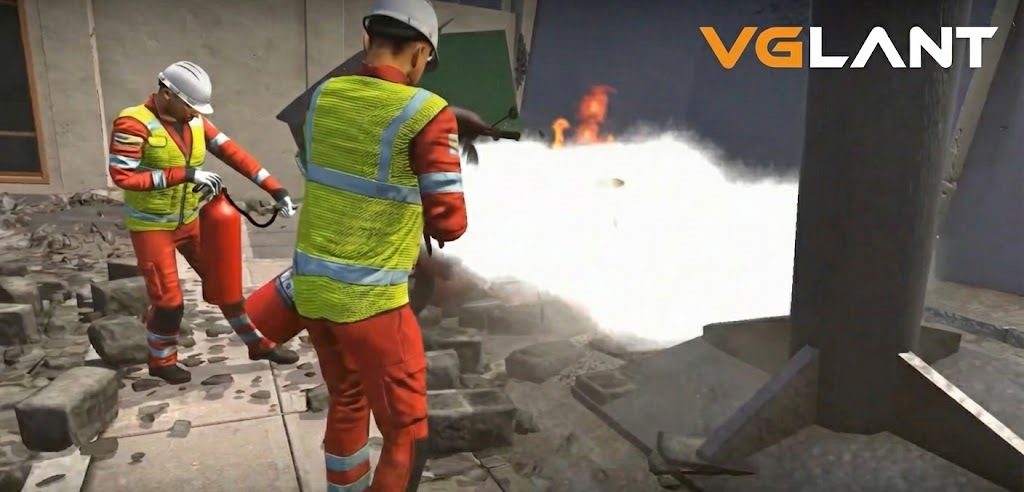
VGLANT’s VR fire safety module presents fire scenarios across all relevant fire classes without the physical hazards that make multi-class conventional training impractical. The trainee encounters a Class A storage fire and must select the correct water-based or multipurpose extinguisher. A subsequent scenario presents a Class B solvent spill fire requiring foam or CO2. Another scenario places the trainee before an energized electrical panel fire (Class C) where the critical first decision is not which extinguisher to grab but whether to de-energize the equipment first. Kitchen fire scenarios require wet chemical agent selection and correct application technique.
Each scenario is rendered with VGLANT’s immersive visual and audio fidelity: different flame characteristics for each fire class, different smoke behavior, different environmental cues that the trainee must learn to read for fire class identification. As VGLANT describes: everything looks and feels real, with zero risk of exposure to actual fire, electricity, or hazardous situations. The training is dangerous; the trainee is safe.
Extinguisher Selection Under Pressure
A critical competence dimension that VGLANT develops is extinguisher selection under time pressure. In a real emergency, the worker does not have the luxury of calmly reading labels and consulting a classification chart. They must identify the fire class from visual and contextual cues, recall which extinguisher type is appropriate, locate the correct extinguisher in the virtual facility, and initiate suppression — all within seconds. VGLANT’s scenarios train this decision chain through repeated practice until the identification-selection-action sequence becomes automated.
VGLANT’s performance tracking captures extinguisher selection accuracy as a distinct competence metric, separate from PASS execution quality. A worker may demonstrate excellent PASS technique but consistently select the wrong extinguisher for Class C scenarios — a critical vulnerability that would be invisible in conventional single-class training and assessment.
Facility-Specific Hazard Matching
VGLANT’s contextual and personalized training enables facility-specific hazard profile matching. A petrochemical installation configures VGLANT scenarios weighted toward Class B flammable liquid fires and Class C electrical fires. A food processing plant weights scenarios toward Class K kitchen fires and Class A storage fires. A manufacturing facility with metal machining operations includes Class D scenarios. Each facility trains its workforce for the specific fire class distribution that matches its actual hazard environment.
Integration with First Aid for Multi-Hazard Scenarios
VGLANT’s compound scenarios combine multi-class fire response with first aid demands that correspond to each fire type. A Class C electrical fire scenario may include an electrocution casualty requiring specific first aid protocols. A Class B chemical fire scenario includes a chemical burn casualty. A Class K kitchen fire scenario involves a thermal burn victim. These compound scenarios develop the multi-hazard awareness that workers in complex facilities need: the understanding that different fire types produce different injury types requiring different first aid responses.
Conclusion
Indonesian industrial facilities contain multiple fire classes, but conventional training addresses only one. This single-class training gap leaves workers unprepared for the fire diversity they actually face and creates the risk of incorrect extinguisher deployment that escalates rather than suppresses emergencies. VGLANT’s VR platform eliminates this gap by enabling safe, immersive training across all fire classes with facility-specific hazard matching, extinguisher selection practice, and compound fire-and-first-aid scenarios. For complex multi-hazard Indonesian facilities, VGLANT provides the only practical method for building comprehensive fire class competence across the entire workforce.