Grenades and flashbangs are used in military and law enforcement operations, including room entry and the clearing of positions. Their use requires correct handling, placement and timing, as well as coordination with the rest of the team.
Live training with these devices is restricted. It requires approved ranges, safety supervision and the cost of each device. Inert training devices are commonly used to practise handling, but they do not show the effect of a throw.
KOMINA, the virtual training platform developed by Komando Imersif Indonesia, includes tactical equipment in its armory. This article describes the equipment and provides a checklist for instructors designing drills with it.
KOMINA’s Tactical Equipment
KOMINA’s armory page lists grenades, flashbangs and other tactical devices with authentic throwing mechanics. Three features are listed:
- Weight-accurate replicas
- Pin-pull simulation
- Blast radius calculation
Trainees move physically in a free-roam VR space, and full-body motion capture records their position, movement and posture. The throw is therefore performed as a physical action and recorded by the system.
Other Relevant Equipment
KOMINA’s wearable gear includes a VR headset with 4K resolution per eye, a 120Hz refresh rate and 3D spatial audio, according to its published specifications. A haptic vest with more than 40 impact zones is listed for simulating bullet impacts and explosions, with adjustable intensity. KOMINA states that its equipment uses low-latency wireless connectivity for unrestricted movement.
Instructor Checklist
- Define the training objective
Decide what the drill will focus on, for example flashbang use before room entry or grenade use against a defended position. Define how performance will be assessed, such as device placement, entry timing, thrower exposure or effect on occupants.
- Build suitable environments
Use the map editor to create rooms with different dimensions, door positions and furniture. The structure builder sets room size and layout. The asset library provides furniture and props, which affect cover and device placement.
Using several different rooms reduces the risk of trainees learning one layout instead of the general skill.
- Place occupants
Use the NPC spawner to place hostile and civilian agents. Hostiles can be set as aggressive, defensive or ambush. Civilians can be set as panicked, compliant or unpredictable. Placing civilians in the room requires trainees to consider their position when placing a device.
Use the sandbox environment to change positions between runs.
- Include the full sequence
Device use is part of a sequence: preparation, team positioning at the entry point, deployment and entry. Practise the complete sequence so trainees learn the timing between deployment and entry, not only the throw.
- Ensure each trainee participates
Rotate the role of device handler so each trainee practises the pin-pull and throw with the weight-accurate replica.
- Review blast radius results
KOMINA calculates the blast radius of each device in the virtual environment. During the debrief, review which agents, and which team members, were inside the effect area.
- Use the replay
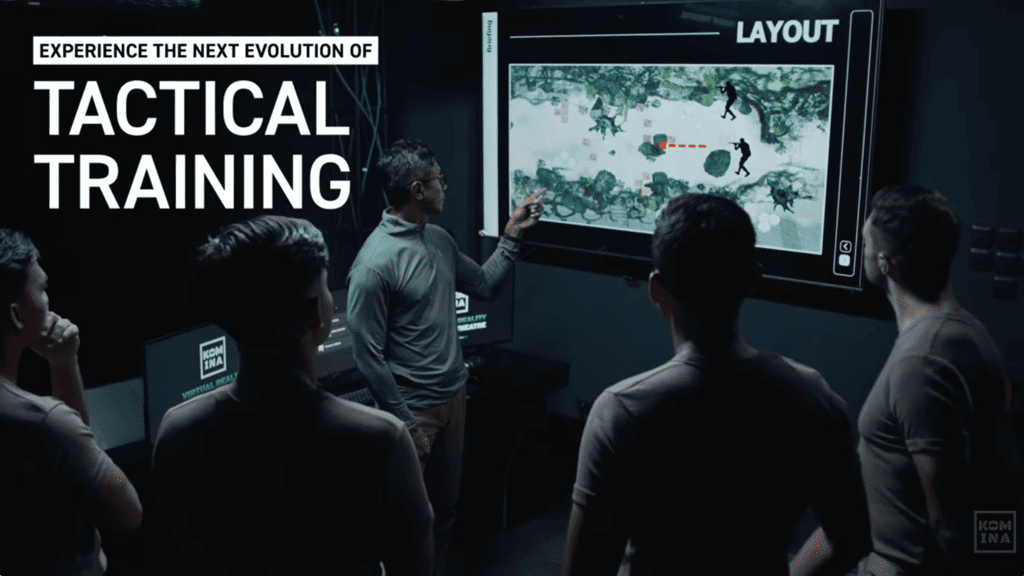
The after-action review provides a full 3D replay from any angle. For each run, check:
- where the device landed in relation to occupants and cover
- the thrower’s position and exposure at the doorway
- the time between deployment and the first entry
- whether civilians or team members were within the effect area
Movement pattern analysis and team synchronisation data show how the team moved during the entry. Heatmaps show where team members were positioned.
- Allow errors to be made safely
In a virtual environment, an incorrectly placed device has no physical consequence. Trainees can make mistakes, review them in the replay and repeat the drill. KOMINA lists risk-free training in dangerous scenarios and reduced ammunition and equipment costs among the benefits of its platform.
- Track progress
Use KOMINA’s progress tracking to compare results across sessions.
- Link to live training
KOMINA states that virtual training complements traditional training rather than replacing it. Live training and qualification with real devices remain necessary. VR drills can be scheduled before and between live sessions so that live training time is used to confirm skills already practised.
Summary
KOMINA’s tactical equipment allows instructors to run flashbang and grenade drills with physical handling, configurable environments and recorded results. Organisations can contact KOMINA to see the equipment in a demonstration.