When VR shows up in defense and security conversations, it almost always gets framed in tactical terms. Marksmanship. Decision-making. Scenario response. The wellness side of immersive training — the mental health dimension — tends to live in the shadow of those topics. It’s also where some of the most operationally meaningful developments are quietly happening. Stress inoculation, resilience building, exposure-based therapy for personnel who’ve come back from operational trauma — all of it is moving out of journal articles and into deployed programs.
This piece walks through that side of the picture. What VR can actually do for mental health in defense and law enforcement contexts. Where the evidence sits today. And what serious programs build in to handle it without causing harm.

The Mental Health Problem in Defense and Security Work
Operational stress isn’t a side issue in military and law enforcement careers. It’s baked into the job. Personnel get exposed to threat environments, traumatic events, cognitive load that won’t let up, sleep deprivation, and decisions where the consequences are measured in lives. Some of those exposures produce acute stress responses that resolve. A meaningful share produce PTSD, depression, anxiety disorders, or substance use issues — and those don’t just affect individual wellbeing. They affect operational readiness.
The numbers shift depending on the population, the conflict exposure, and how researchers measure them. Studies on combat-exposed personnel consistently land PTSD rates in the 10-20% range. Subclinical stress symptoms hit a much larger slice. Law enforcement populations show comparable patterns. Career-long accumulation of traumatic incidents produces measurable mental health effects across a substantial portion of the workforce.
Conventional responses have leaned heavily on post-incident support. Counseling. Peer programs. Employee assistance services. Structured debriefs after critical incidents. All of this matters, and it works for the people who actually access it. The fundamental limit is that it’s reactive. By the time these supports kick in, the operational exposure has already happened and the psychological consequences are already taking shape.
Pre-emptive approaches — building resilience before the exposure rather than treating it afterward — have been harder to put into practice. Resilience training as a concept has lived inside military programs for decades. The methods available to actually build it at scale have been thin. Classroom-based stress management. Lectures on coping mechanisms. Brief intervention programs. Modest results at best. The gap between what operational populations need and what conventional methods can deliver has been wide.
This is where VR has started to shift the equation.
Stress Inoculation: Building Tolerance Before You Need It
Stress inoculation is the most operationally relevant mental health application of VR. It’s also the one that ties most directly back to the tactical training side of immersive technology.
The principle is simple. People who’ve experienced stress under controlled conditions — repeatedly, in advance — perform better when the real version shows up. They also develop fewer post-incident psychological symptoms. The neurological mechanism is straightforward: repeated controlled exposure to stress responses builds the prefrontal cortex’s capacity to keep executive function online while the amygdala is firing. The brain learns, through experience, that stress doesn’t have to swamp cognition.
Conventional training does produce some stress inoculation as a byproduct. Live-fire ranges produce stress. Field exercises under fatigue produce stress. The problem is dosage. Stress shows up as a side effect of the training, at whatever frequency and intensity the schedule happens to deliver. Deliberate stress inoculation — controlled exposure across the full range of operational stress conditions — has been hard to engineer through conventional methods.
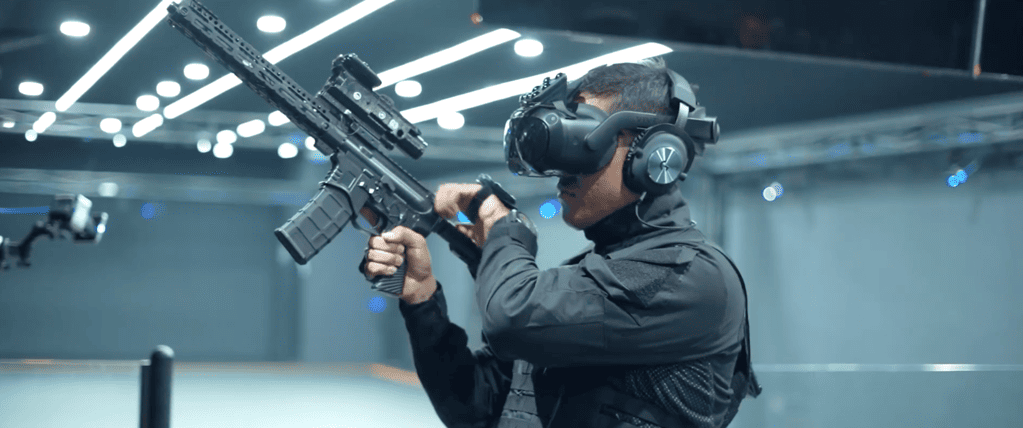
VR finally makes deliberate stress inoculation practical. Trainees can be put through high-stress scenarios — active threat environments, casualty exposure, time-pressure decision-making, communications chaos — across enough variety and frequency to actually build tolerance. The exposure happens in controlled conditions. Physiological responses can be tracked. Intensity can be calibrated to the individual trainee. And every session ends with structured debriefing that processes what happened.
Research on VR-based stress inoculation in military populations keeps landing on the same finding. Personnel who go through structured VR stress exposure before deployment show smaller stress responses to operational events, recover faster from acute stress episodes, and report lower rates of post-deployment symptoms compared to control groups. Effect sizes vary across studies. The direction does not.
The operational takeaway here is direct. Stress inoculation isn’t a wellness program bolted onto tactical training. It’s a property of well-designed tactical training, and it produces mental health benefits as a structural outcome — not as a happy accident.
Resilience Training, Built Into Operational Preparation
Resilience — the capacity to hold function together under stress and bounce back quickly afterward — has been a target of military training programs for decades. The methods have changed. The same problem keeps showing up regardless: resilience is hard to build through instruction alone.
Lecture-based resilience training works fine for understanding. Personnel can name coping frameworks, recite the techniques, identify the symptoms those techniques are supposed to address. Translating that knowledge into actual behavior under stress is a different matter. Knowing that controlled breathing helps under pressure is one thing. Reflexively reaching for controlled breathing when pressure hits is another. The space between cognitive understanding and automatic behavior is exactly where conventional resilience training has had the toughest time delivering.
VR closes part of that gap by folding resilience practice directly into scenario training. Trainees learn the cognitive techniques in classroom settings — controlled breathing, attentional shifting, cognitive reframing, decision-making under load. Then they put those techniques to work inside VR scenarios where the stress is real enough to require them. Repetition turns the techniques into automatic responses rather than conscious procedures someone has to remember to apply.
Specific resilience components VR-integrated training targets:
Physiological self-regulation. Heart rate management, breathing control, modulating the stress response — practiced inside scenarios that produce genuine physiological activation. Trainee biometrics can be monitored across sessions, with feedback on when self-regulation kicked in effectively and when it didn’t.
Cognitive flexibility. Holding decision-making capacity together when the initial read of a situation turns out to be wrong. VR scenarios where conditions shift mid-event, threats emerge from unexpected directions, or information turns out to be bad — these drill the cognitive flexibility that keeps tunnel vision from setting in.
Recovery from acute stress. The after-action transition — moving from high-stress engagement back to a normal operating baseline — gets practiced inside VR debriefing protocols. Trainees learn the recovery patterns that make sustained operations possible without stress quietly piling up over time.
Team-level resilience. Squad and unit scenarios drill the communication and mutual-support patterns that buffer individual stress. Personnel learn that asking for backup, signaling uncertainty, and supporting teammates under stress are operational behaviors. Not signs of weakness.
The cumulative effect: personnel who arrive at real operational events carrying practiced resilience skills rather than a theoretical understanding of resilience concepts.
Exposure Therapy and Post-Incident Treatment
The other big mental health application of VR sits on the treatment side rather than the prevention side. VR-based exposure therapy for personnel who already carry PTSD or related conditions.
Exposure therapy is an established, evidence-based treatment for PTSD. The mechanism involves controlled re-exposure to trauma-related stimuli in safe conditions. The brain reprocesses the traumatic memory, and the conditioned fear response gradually diminishes. Conventional exposure therapy uses either imagined exposure (the patient describes the event in detail under therapist guidance) or in-vivo exposure (gradual real-world re-exposure to safe versions of trauma triggers).
VR adds a third modality. The patient steps into a controlled simulated version of the traumatic context — a combat environment, an urban scene, a vehicle incident — calibrated to engage trauma memory without overwhelming the patient. The therapist controls intensity, can adjust the scenario in real time, and can integrate the exposure with the cognitive processing components of standard evidence-based PTSD protocols.
Research on VR exposure therapy for combat-related PTSD has been piling up for roughly two decades now. Programs at the U.S. Department of Veterans Affairs and partner institutions have produced much of the clinical literature. Outcomes are reported as comparable to — or in some cases better than — imagined exposure for combat PTSD, with particular advantages for patients who struggle to engage traumatic memory through verbal description alone.
The operational implication for defense and security organizations is worth flagging. VR is increasingly part of the mental health treatment infrastructure, not just the training infrastructure. Programs that combine VR-based prevention (stress inoculation, resilience training) with VR-supported treatment (exposure therapy where clinically indicated) cover a more complete mental health continuum than either piece on its own.
That integration is still uneven across most national defense and security systems. The clinical infrastructure required for VR exposure therapy — licensed mental health professionals trained in trauma-informed VR protocols — sits separately from the training infrastructure in most cases. Programs that bridge the two effectively are still relatively rare. Which is precisely where the operational opportunity lies for organizations building mental health capability with some intent.
Trauma-Informed Design Is a Baseline, Not a Feature
Any serious VR application to mental health — whether prevention or treatment — needs trauma-informed design principles wired into the program from day one. Not as an optional layer. As the foundation. It’s the difference between programs that deliver mental health benefits and programs that quietly produce harm.
Trauma-informed design has a handful of specific components in defense and security training contexts:
Pre-scenario briefings. Trainees know roughly what intensity range they’re walking into before the session starts. Surprise exposure to high-stress scenarios is contraindicated — especially for anyone with prior trauma history.
Voluntary pause and exit. Trainees can stop the scenario at any moment, for any reason, no penalty attached. Control belongs to the person inside the simulation, not the instructor or the program.
Calibrated intensity. The scenario intensity should match the trainee’s current capacity. New trainees and personnel returning from deployment-related stress events get different intensity profiles than experienced operators building advanced capability.
Post-scenario debriefing. Sessions end with structured processing — not with the trainee yanking the headset off and walking out the door. The debrief covers tactical decisions and psychological responses, with explicit attention to whether the session produced productive stress (the goal) or maladaptive distress (the failure mode).
Clear pathways to support. Personnel who need additional mental health support after a session need to know exactly where to go and how to get there — through unit resources, organizational mental health services, or external clinical referral. A program that produces stress without supporting the people who experience adverse responses is a program that produces harm. Full stop.
Screening before exposure. Personnel with active PTSD, acute stress disorder, or other conditions that contraindicate stress exposure should be flagged before participation, with appropriate accommodations or alternative training paths.
These components apply regardless of the technical platform. They’re program design requirements, not VR-specific features. Programs that take mental health seriously build them in deliberately. Programs that treat VR as a tactical tool with mental health benefits showing up as a side effect tend to skip them — and the consequences become visible over time.
What This Means for Program Design
Pulling the threads together produces a few clear implications for how organizations should think about VR’s mental health dimension.
Mental health and tactical benefits aren’t separable. A well-designed tactical scenario produces stress inoculation and resilience as structural outcomes. Treating VR training as either “tactical” or “wellness” creates a false split. The same scenario that drills tactical decision-making is also building stress tolerance and resilience capacity at the same time.
Design choices matter as much as the technology. A VR system used without trauma-informed protocols can cause harm. The same system used inside a properly designed program produces clear benefit. The technology is the platform. The protocols determine the outcome.
Integration with mental health infrastructure matters. VR training that connects into organizational mental health services produces more value than VR training operating in isolation. Personnel who have adverse responses during sessions need pathways forward. Personnel returning from operational stress events benefit from VR-supported recovery protocols. Both integrations require deliberate program design.
Pre-emptive investment beats reactive response. The cost of building stress inoculation and resilience into training is substantially lower than the cost of treating PTSD, depression, and related conditions after they develop. The case for pre-emptive mental health investment through VR is strong on both wellness grounds and operational readiness grounds.
Long-term evaluation is non-negotiable. Mental health outcomes develop across months and years, not weeks. Programs that evaluate VR mental health applications need longitudinal measurement, not short-cycle performance metrics. This isn’t a barrier to deployment. It’s a real factor in how programs should be assessed and refined.
The mental health dimension of VR training is one of the more underdeveloped areas of military and law enforcement program design — despite being one of the most operationally significant. Organizations that build it in deliberately tend to produce both stronger tactical outcomes and healthier personnel over the long haul.
KOMINA Virtual Training Capabilities
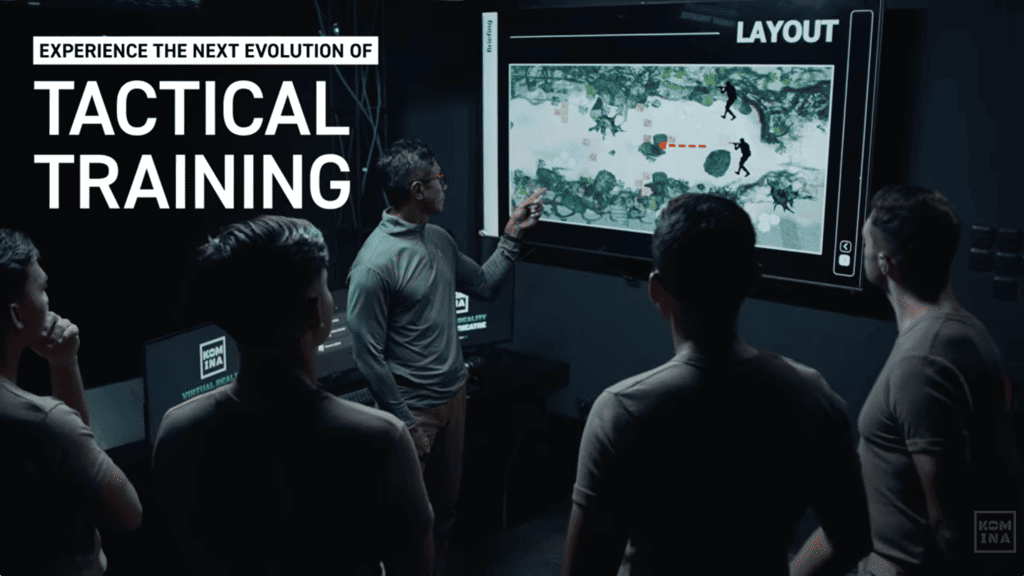
KOMINA — PT Komando Imersif Indonesia — develops virtual training systems for military and law enforcement organizations. The platform is built around scenario-based training across the categories most operationally relevant to defense and security work.
Single Combat covers individual weapons proficiency, marksmanship, and engagement decision-making across service weapons inventory. Trainees develop fundamentals on tracked weapon-form props before live range time.
Team Combat covers small unit tactics, room clearing, coordinated movement, and communication under pressure. Squad-level scenarios run in environments matched to actual operational settings.
HALO and HIHO modules cover high-altitude parachute insertion training — exit sequence, freefall management, canopy deployment, and landing procedures. These scenarios provide extensive rehearsal opportunity for operations that are inherently high-risk during live training.
Vehicular Battle covers armored vehicle crew operations, tactical driving, convoy procedures, and response to vehicular threats. Motion platforms paired with the simulation reproduce vehicle dynamics with a level of fidelity static trainers can’t match.
Command Center covers tactical operations center procedures, situational awareness management, and multi-unit coordination. Senior personnel rehearse command and control scenarios with realistic information flow and decision pressure.
Custom Projects address specific operational requirements outside the standard module set. Mission-specific rehearsals, specialized scenarios, and integration with existing training infrastructure are scoped on a per-project basis. For organizations building deliberate mental health and resilience programs, custom scenarios can be calibrated to specific stress inoculation and resilience training requirements, with trauma-informed design protocols built into the program structure from the start.
The platform is built in Indonesia for the operational requirements of defense and security organizations operating in Indonesian and regional contexts. Scenarios reflect locally relevant environments, terrain, equipment, and doctrinal references. Voice prompts and UI default to Bahasa Indonesia, with English available for joint exercises and regional cooperation. Performance data is logged for unit-level review and integrates with existing training records.
For capability briefings, scenario scoping, or pilot deployments — including programs with explicit mental health and resilience components — KOMINA can be reached at https://komina.co/ or +62 812 9696 7887.