When someone collapses at work, the first minutes matter. A trained first aider follows a structured sequence to check for danger, assess the casualty and provide basic life support. This sequence is often called the primary survey. This article explains one common version, DRSABCD, and how VR training can help first aiders practise it.
First Aid Requirements in Indonesia
In Indonesia, first aid in the workplace (P3K) is regulated by Minister of Manpower and Transmigration Regulation No. PER.15/MEN/VIII/2008. The regulation requires employers to provide first aid, including trained first aid officers (petugas P3K) and first aid facilities such as first aid kits. The number of officers and kits depends on the number of workers and the level of risk.
The regulation also requires that first aid officers hold a licence, which is obtained after completing first aid training. First aid officers are expected to be available during working hours, including on each shift where work is done in shifts.
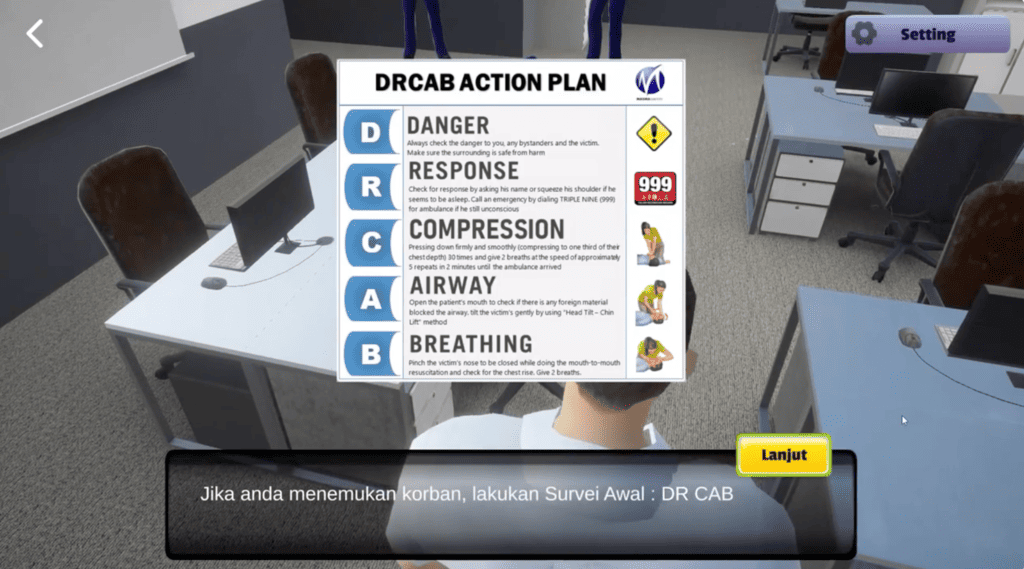
The Primary Survey: DRSABCD
DRSABCD is a sequence used by several first aid organisations. Other organisations use similar sequences with slightly different letters. Training should follow the current guidelines of a recognised first aid or resuscitation body.
D: Danger
Check for danger to yourself, bystanders and the casualty. Examples include electrical hazards, traffic, moving machinery, fire or chemicals. Do not approach until it is safe.
R: Response
Check whether the casualty responds. Speak to them and gently squeeze their shoulders. A casualty who does not respond needs urgent help.
S: Send for Help
Call for help or ask a bystander to call. In a workplace, this usually means contacting the internal emergency response team and calling emergency services.
A: Airway
Open the airway and check for obstructions. Guidance on airway management varies, so first aiders should follow the method taught in their certified course.
B: Breathing
Check for normal breathing by looking, listening and feeling. Abnormal or absent breathing indicates the need for CPR.
C: CPR
Start cardiopulmonary resuscitation if the casualty is unresponsive and not breathing normally. Follow the compression and breathing guidance of the relevant resuscitation guidelines.
D: Defibrillation
Attach an automated external defibrillator (AED) as soon as one is available and follow its instructions.
Why the Sequence Is Hard to Remember
First aiders often complete a course and then rarely use their skills. In an emergency, stress can cause people to skip steps, such as checking for danger, or to delay calling for help. Classroom practice on manikins teaches technique, but it usually takes place in a calm room without distractions.
How VR Training Helps
VGLANT lists first aid among its VR safety modules. Its fire extinguisher product page also describes the training as an emergency first response solution for civilians.
In a VR first aid scenario, a trainee can practise the primary survey in a simulated workplace. The scenario can include:
- hazards that must be identified before approaching the casualty
- a casualty whose response must be checked
- a requirement to call for help
- decisions on airway, breathing and CPR
VGLANT describes its scenarios as randomised. The type of hazard or the condition of the casualty can change between sessions, so trainees must assess each situation rather than repeat a fixed pattern.
Recording Performance
VGLANT’s platform records task duration, reaction time and actions taken. For the primary survey, this can show:
- whether the trainee checked for danger before approaching
- how long it took to call for help
- whether steps were done in the correct order
- whether any step was skipped
Supervisors and P3K coordinators can use this data to plan refresher training.
Limits of VR
VR training does not replace certified first aid courses or hands-on CPR practice on manikins. Physical skills, such as chest compression depth and rate, require practical training with suitable equipment. VR is most useful for practising decision-making and the order of actions.
Summary
The primary survey gives first aiders a structured way to act in the first minutes of an emergency. VR training allows them to rehearse it in realistic settings and gives coordinators a record of performance. Organisations interested in VR first aid training can contact VGLANT for a demonstration.